
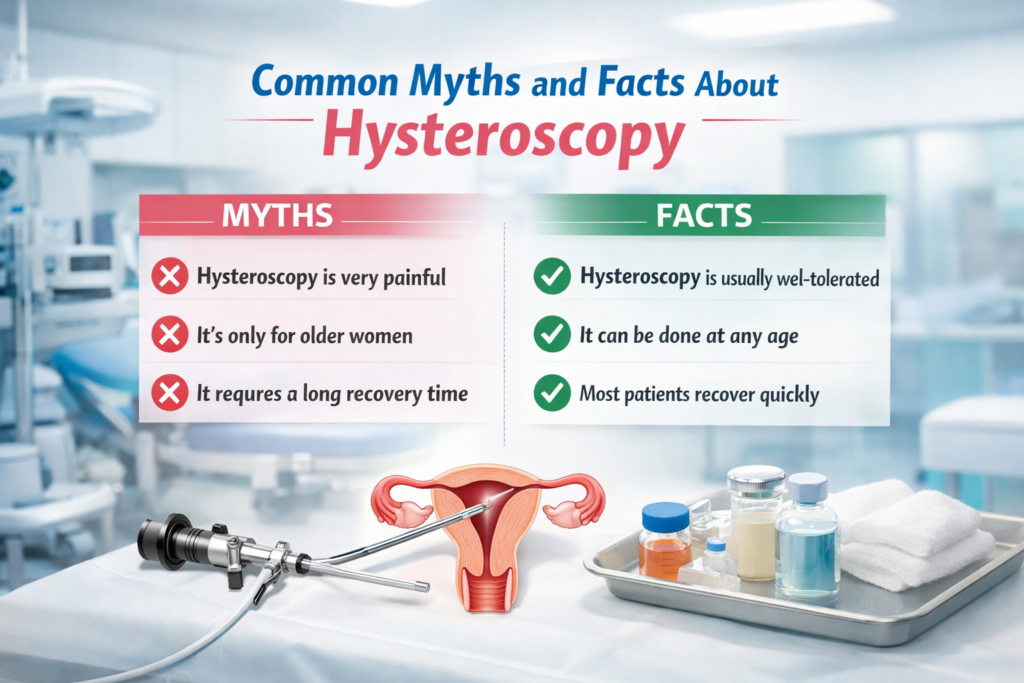
Hysteroscopy is a commonly recommended procedure in gynecology, but many women still feel anxious when they hear about it. This is mainly due to myths and misunderstandings surrounding the procedure. Understanding the real facts about hysteroscopy can help patients feel more confident and informed before undergoing the treatment.
Hysteroscopy is a minimally invasive procedure that allows doctors to examine the inside of the uterus using a thin medical instrument called a hysteroscope. It helps doctors identify problems accurately and sometimes treat them during the same procedure.
What Is Hysteroscopy?
Hysteroscopy is a procedure used to check the uterine cavity for abnormalities. A thin, lighted instrument called a hysteroscope is gently inserted through the cervix into the uterus. The camera attached to the instrument allows doctors to clearly view the uterine lining.
Doctors usually recommend hysteroscopy to diagnose or treat several conditions related to the uterus.
Common conditions diagnosed with hysteroscopy
- Abnormal or heavy menstrual bleeding
- Uterine polyps
- Fibroids inside the uterus
- Fertility-related concerns
- Repeated miscarriages
- Scar tissue in the uterus
One of the important facts about hysteroscopy is that the procedure does not require large surgical cuts, which makes it safer and easier for patients compared to traditional surgery.
Common Myths and the Real Facts about Hysteroscopy
There are several myths that create unnecessary fear about hysteroscopy. Knowing the real facts about hysteroscopy can help patients understand the procedure better.
Myth: Hysteroscopy is a major surgery
- Hysteroscopy is actually a minimally invasive procedure.
- It does not involve large incisions or stitches.
- Most procedures are completed within a short time.
Myth: The procedure is extremely painful
- Most patients feel only mild discomfort similar to menstrual cramps.
- Doctors may use anesthesia or sedation when required.
- The procedure is usually well tolerated.
Myth: Recovery takes a long time
- Many patients return to normal activities within a day or two.
- Mild spotting or cramps may occur but usually settle quickly.
These facts about hysteroscopy show that the procedure is much simpler than many people think.
Benefits of Hysteroscopy
Hysteroscopy has become an important diagnostic and treatment tool in modern gynecology because it offers several advantages.
Key benefits include
- Accurate diagnosis of uterine conditions
- Minimally invasive procedure with no external cuts
- Short procedure time
- Faster recovery compared to traditional surgery
- Ability to diagnose and treat problems in the same procedure
Because of these advantages, many doctors prefer hysteroscopy when evaluating uterine health.
When Doctors Recommend Hysteroscopy
Doctors may suggest hysteroscopy when other tests cannot clearly identify the cause of uterine problems. The procedure allows a direct view of the uterine cavity, which helps in identifying abnormalities quickly.
Situations where hysteroscopy may be recommended
- Unexplained heavy menstrual bleeding
- Irregular menstrual cycles
- Difficulty in conceiving
- Evaluation after repeated miscarriages
- Removal of polyps or small fibroids
Understanding these facts about hysteroscopy helps patients realize why the procedure is often recommended for accurate diagnosis and treatment.
Hysteroscopy Care at VVR Chaitanya Hospital, Raichur
Patients looking for reliable gynecological care in Raichur can visit VVR Chaitanya Hospital for evaluation and treatment. The hospital focuses on providing patient-friendly care with modern diagnostic methods.
Hysteroscopy procedures are performed under the guidance of experienced doctors Dr. Sridhar and Dr. Lavanya. They carefully assess each patient’s condition and recommend appropriate treatment based on individual needs.
Conclusion
Knowing the real facts about hysteroscopy can help remove unnecessary fear about the procedure. Hysteroscopy is a safe and minimally invasive technique that allows doctors to diagnose and treat uterine conditions effectively.
By understanding these facts about hysteroscopy, women can make informed decisions about their reproductive health and seek timely medical care when needed.
Comments: