
When a doctor mentions endoscopy, most people instantly feel nervous. But the truth is—it’s a simple and powerful way to understand what’s happening inside your body. If you know the types of endoscopy, the fear usually disappears and gets replaced with clarity.
Let’s break it down in a way that actually makes sense.
🔍 So, What Exactly is Endoscopy?
Think of endoscopy as a tiny camera journey inside your body. Doctors use a flexible tube with a light and camera to look at internal organs without surgery.
Instead of guessing the problem, this method gives a clear visual answer.
👉 Why people prefer it:
- No major cuts or stitches
- Quick diagnosis
- Faster recovery compared to surgery
There are different types of endoscopy, and each one focuses on a specific area of the body.
🧠 Why One Type Isn’t Enough?
Your body isn’t one single system—it’s a combination of many. So naturally, one single method can’t examine everything.
Here’s a simple way to understand:
- Stomach problem? → A camera goes through the mouth
- Intestine issue? → A different route is used
- Lung concern? → Completely different approach
That’s why doctors rely on multiple types of endoscopy to get accurate results instead of assumptions.
🩻 Let’s Talk About the Main Types
Now comes the practical part. Among all types of endoscopy, these are the ones doctors use most often in real life.
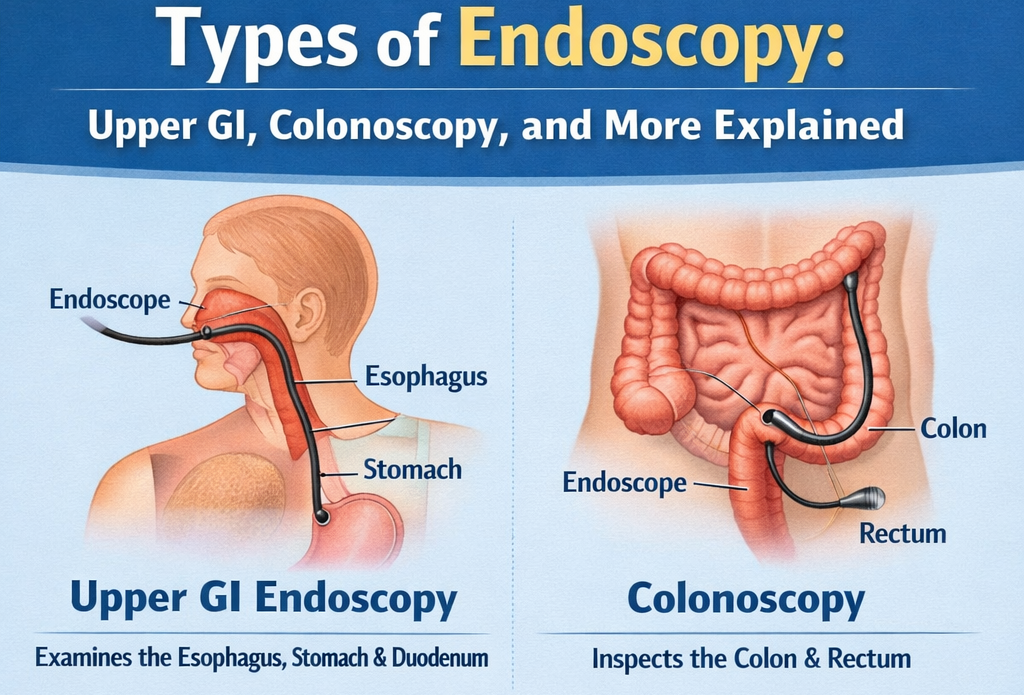
👉 Upper GI Endoscopy (Most Common One)
If you’ve ever had acidity or burning sensation, this might be the test your doctor suggests.
It looks into:
- Food pipe
- Stomach
- Upper intestine
💡 Usually recommended when:
- Acid reflux doesn’t go away
- Frequent vomiting
- Unexplained stomach pain
👉 Colonoscopy (Life-Saving Screening)
This is not just a test—it can actually prevent serious diseases.
It focuses on:
- Entire large intestine
✔ Helps detect:
- Early-stage cancer
- Polyps before they turn dangerous
- Internal bleeding causes
Among the types of endoscopy, this one is strongly advised after a certain age.
👉 Sigmoidoscopy (Short & Quick Check)
Not every case needs a full colonoscopy. Sometimes, a shorter test is enough.
Best suited for:
- Lower colon issues
- Quick screenings
⏱ Takes less time and is less intensive.
👉 Bronchoscopy (For Breathing Issues)
When the problem isn’t in your stomach but in your lungs, doctors switch approach.
Used to check:
- Airways
- Lung passages
👉 Recommended if:
- You have a long-term cough
- Breathing feels restricted
This is one of the specialized types of endoscopy.
👉 Cystoscopy (Urinary Check)
This one is completely different from digestive tests.
It helps doctors examine:
- Bladder
- Urine passage
✔ Useful when:
- There’s pain while urinating
- Blood appears in urine
👉 Capsule Endoscopy (Modern & Easy)
This is where technology makes things super simple.
Instead of tubes, you just swallow a small capsule.
✨ What makes it unique:
- No discomfort
- No hospital stay
- Captures images naturally
Among advanced types of endoscopy, this is the most patient-friendly option.
⚠️ When Should You Actually Consider It?
Many people ignore symptoms until they become serious. That’s risky.
Doctors usually suggest different types of endoscopy when symptoms don’t go away.
Watch out for signs like:
- Constant stomach discomfort
- Trouble swallowing food
- Blood in stool
- Sudden weight loss
👉 If something feels “not normal” for long, it’s better to check early.
✅ Safety: What Most People Worry About
Let’s address the common fear—“Is it safe?”
Short answer: Yes.
All types of endoscopy are routine procedures done daily in hospitals.
What you might feel:
- Slight uneasiness
- Temporary bloating
- Mild throat irritation
Serious complications? Very rare.
🌟 Why Doctors Prefer Endoscopy
Instead of guessing, doctors prefer seeing the problem directly.
Here’s why different types of endoscopy are so valuable:
✔ Accurate diagnosis
✔ Detects problems early
✔ Can treat small issues instantly
✔ Avoids unnecessary surgeries
In many cases, it doesn’t just find the issue—it solves it.
📝 Final Words You Should Remember
At the end of the day, understanding the types of endoscopy gives you control over your health decisions.
Don’t let fear delay important tests.
👉 Just remember:
- Early check = better treatment
- Most procedures are quick
- Technology has made it very comfortable
Taking action at the right time can make a huge difference.
Comments: